Field Note 007: The Archeron Phenotype — Merchant Blood, Royal Angles, and Malnutrition
Building Feyre, Nesta and Elain from the Bones Out
My fellow Maasversians, pour a glass of something rich and pull up a chair, because we need to talk about what happens when BookTok shorthand flattens three of the most visually complex sisters in modern fantasy into interchangeable, cookie-cutter templates. In part that is because of current tool limitations on how much we as creators can build quickly while holding consistency without sinking in not only hours—but weeks of design… which we have happily sunk here for the love of Maas in order to build something based in real human structure and diversity.
Now don’t get me wrong—I love the fan art community. The sheer creativity, the alternate universe designs, the scripts, and seeing how readers interpret the worlds created by Sarah J. Maas and our other favorite fantasy authors is incredible. It’s just sometimes I can’t tell if it’s Fourth Wing’s Xaden or Rhys, or Kingfisher someone is representing, because they end up all looking the same. The renders are gorgeous, so I’m not really complaining… I’ll still very much watch them with joy. But when you spend enough time combing through Sarah J. Maas’s text—not the algorithm consensus, but the actual ink on the page—you understand the characters have more depth. And I crave to share my version of them with you in honor of her text. For example, the Archeron sisters aren’t just three blonde-ish women with differing attitudes. Their bones tell a physical history of class collapse, trade routes, childhood famine, and High Fae metamorphosis.
As an aside: I hope you always imagine yourselves as the lead characters you connect with in a story. We all deserve that main character energy. What follows is my personal interpretation of the text—reconstructing the three Archeron women from both canonical lore and a bioarchaeological lens that understands the real-world diversity of human phenotypes. And humans are humans – so we make the assumption Prythian follows the same human evolution and biological patterns of our planet. So take a sip and explore with me a version of these women that directly aligns with Maas’s written descriptions and our atelier flare.
Our core anchor naturally started with Feyre—the sister who guided us into Prythian. I didn’t start with a dreamy fantasy filter in how I saw her in my mind. I started with her father’s shipping ledgers, the bitter memory of her mother, and an empty wooden pantry in a freezing cottage.
The Merchant Line: That “Continental” Maritime Heritage
Let’s talk about the lineage that rarely gets unpacked: the Archerons were not titled landed gentry. The “Prince of Merchants” built trade wealth. His ships sailed the continent, navigating foreign ports and maritime channels long before his debts were called in and his knees were shattered by creditors.
In real-world mercantile history, merchant dynasties aren’t homogenous. They travel, trade, intermarry across coastal hubs, and absorb heritage from across open waters. I’ve always read the Archeron sisters as carrying that subtle, dynamic coastal heritage—a lineage with a touch of something similar to the worldly Mediterranean trade routes that distinguishes them from the insular mortal peasantry of their village.
You see it directly in how SJM describes Feyre’s skin. She isn’t flat porcelain. In Chapter 1 of A Court of Thorns and Roses, she notes:
“My skin was pale from winter and poor food, but I had my mother’s straight nose and mouth, and my father’s high cheekbones.”
Her baseline carries a natural golden undertone that reacts immediately to sunlight and warmth. In Chapter 9 of ACOTAR, when Alis dresses mortal Feyre in the Spring Court, the fabric immediately draws out that warmth:
“The tunic was a pale, shimmering peach—the color of dawn. It made the gold in my brown hair stand out, and warmed my pale skin until I almost looked healthy.”
Peach, warm apricot, pale and soft pinks tones immediately bring underlying warmth straight to the surface on many olive complexions. (And olive skin tones often share a biological link to golden-brown and various multitonal hair.)
Later, in Chapter 1 of A Court of Wings and Ruin, that exact golden resonance returns under the Prythian sun:
“The sunlight gilded my skin, the pale pink fabric of my dress shimmering like rose petals in the morning breeze.”
Anyone with an olive undertone has experienced this unique color theory behind these text descriptions: while icy, stark pastels can wash fair olive skin out and leave it looking sallow or grey, warm peach and soft, petal-pink tones do the exact opposite. Their warm red and apricot pigments actively neutralize greenish-neutral undertones, pushing the skin’s underlying golden warmth to the surface and making it literally look gilded in natural light.
But then jump to ACOMAF during Starfall, when she steps out in that gossamer, deep midnight-blue gown stitched with starlight and silver. A strictly warm, yellow-based complexion gets completely overpowered by midnight blues and cool liquid metallics. Yet Feyre still stuns under the Velaris sky just as effortlessly as she did in the sunny rose gardens of Spring, described as breathtaking draped in starlight and midnight. That chameleon quality—looking equally lethal in warm Spring Court gold and draped in Night Court liquid starlight—only belongs to skin with dimensional depth and the iconic pale golden olive undertone that some would also call neutral-to-olive.
The Regal Edge: Where High Society Meets Survival
And then you have their mother—the ruthless social architect balancing the father’s freewheeling maritime empire. A mystery in her own right: was she human? Related to the mortal queens? Fae-descended? There are countless theories.
What the text explicitly confirms is that she is not remembered with warmth. She was cold, sharp, and relentlessly calculating—a woman who treated daughters like high-stakes social investments. While their father sailed the trade currents, their mother ruled the drawing rooms of the merchant elite, obsessing over aristocratic alliances. In Chapter 4 of ACOTAR, Feyre reflects:
“My mother had been a creature of society, ambitious and cold, interested only in climbing higher… she had loved Nesta best, because Nesta was born with that same cold, sharp edge.”
That maternal line is where their severe, regal architecture comes from: the straight noses, high cheekbones, and that imperious carriage that kept them looking like fallen nobility even while starving in rags.
When Tamlin observes human Feyre during dinner in Chapter 21 of ACOTAR, he catches that exact contrast:
“You have a lovely face,” he said quietly.
“No, I don’t,” I muttered, glancing down at my plate.
“Yes, you do. Sharp, fierce—soft, too. High cheekbones that bring out your eyes. Slightly … slightly arched brows.”
When Feyre returns to the mortal estate in Chapter 32, she looks into the mirror and confirms it herself: “My cheekbones were high and prominent, my mouth soft but wide, and my eyes—a clear, pale grey-blue—were large and watchful.”
Nesta inherited the full brunt of her mother’s haughty steel and cutting bone structure; Elain received the soft, curated grace meant to disarm suitors in high-society parlors; and Feyre was caught between both worlds—possessing that same sharp, aristocratic nose and jaw, but weathered by winter winds and hardened by the forest floor.
The Anatomy of Bone Structure: Classical Form vs. Social Media Homogenization
Let’s unpack that physical blueprint laid out across Chapters 1, 21, and 32—where Feyre notes inheriting her “mother’s straight nose and mouth” alongside her “father’s high cheekbones,” later affirmed by Tamlin’s assessment of a face both “sharp, fierce—soft, too” with “high cheekbones that bring out your eyes.”
When algorithmic fantasy art reads those words, it almost invariably defaults to the same homogenized template: a tiny, pinched button nose perched between synthetic filler-cheeks and an ultra-narrow anime jaw. But Sarah J. Maas didn’t write an airbrushed doll; she wrote a woman built from sharp mercantile architecture, maternal severity, and raw physical endurance.
To translate those lines into authentic bone structure, you have to look at classical sculpture and real facial anatomy:
- The Straight Nose: In classical portraiture, a “straight nose” (the straight Grecian profile) has nothing to do with scooped ski slopes or upturned tips. It means an unbroken, linear descent of the nasal dorsum from between the brows down to the tip—free of a severe Roman dorsal hump, but built with genuine bone density, width, and structural support. This can cover a multitude of nose shapes, not just our design. It’s an anchor feature: sturdy enough to withstand freezing wind and balanced enough to frame the natural breadth of a wide mouth.
- The High, Prominent Cheekbones: High cheekbones (zygomatic arches that sit high on the skull, closer to the orbital sockets) don’t mean round, bulbous apples. In a lean face weathered by famine, high cheekbones create natural structure beneath them, casting distinct downward shadows toward the corners of the jaw. They widen the upper midface, making the eyes look expansive and deep-set, while catching sharp top-lighting like chiseled stone.
- The Regal, Defined Jaw: A high-society maternal heritage doesn’t lend itself to a weak, sloping chin or a delicate, round jawline. SJM repeatedly connects the Archeron jawline to their stubbornness and regal bearing. Anatomically, this means a clean, well-defined mandibular angle—broad enough to house a wide, expressive mouth, with a tapered chin that creates that signature “heart-meets-diamond” geometry. It gives the lower face an unmistakable, grounded weight.
Honoring these traits meant refusing to soften the angles. It meant rendering a face with authentic human substance: high, shadow-casting cheekbones that draw immediate focus to watchful sea-grey eyes, an unbroken nasal bridge that looks carved rather than clipped, and a jawline built with enough clean steel to hold its own against High Lords.
The Famine Gap: The Bioarchaeology of Feyre’s Height
Here is a hill I will happily defend with calipers and text citations: Feyre is noticeably shorter than Nesta and Elain, and the reason is biological.
In Chapter 2 of ACOTAR, the physical hierarchy is established immediately:
“Nesta was the eldest, and the tallest, followed by Elain, who possessed a delicate, willowy grace. I was the youngest, smaller than both of them, and leaner from years of tracking prey.”
Nesta and Elain spent their foundational developmental years fed on the profits of their father’s peak wealth. They had proper early childhood nutrition, warmth, and consistent calories during critical skeletal growth windows. By the time ruin stripped them bare, the elder two had already banked their childhood bone growth.
Feyre didn’t. She spent her formative childhood and teen years starving in a drafty cottage, rationing crusts, splitting scraps, and tracking prey in freezing snow. Severe childhood malnutrition directly impacts adult stature; her metabolic reserves had to go toward baseline organ maintenance and muscle resilience rather than skeletal elongation.
When Feyre is remade into High Fae Under the Mountain, she experiences a dramatic growth spurt. In ACOMAF, she mentions tripping over her own limbs as she adjusted to her longer legs and heightened center of gravity. But when the Cauldron forces Nesta and Elain through that same High Fae transformation, the baseline blueprint remains intact:
“Nesta stood like a carved pillar of steel… taller than me even before the Cauldron, she now commanded the room with an icy, statuesque severity.”
The elder sisters step out of the Cauldron statuesque and imposing. Feyre gains Fae height, but relative to her sisters, she remains shorter even in fae form— grounded and lethal because her center of balance was forged in survival, not leisure.
Three Sisters, One Bloodline, Zero Duplicates
When mapping their portraits, my goal was establishing a clear genetic thread without erasing their individual canon traits:
Feyre (The Gilded Shadow)

Her hair is true golden-brown—not ash, not copper, but a multi-tonal golden brown that glows in daylight with ribbons of warm hazelnut and pale gold. Her eyes were the most delicate to calibrate because “blue-grey” is so often rendered as flat ice. In my interpretation, they carry the depth of a dark northern sea under heavy mist: slate-grey at the outer limbal ring with a stormy blue interior that shifts with the light. Her pale golden-olive skin honors the textual nuances of her complexion, balancing regal high cheekbones with the scrappy, weathered edge of a huntress.
A note on the optical nuance of her eyes: SJM gives us two sides of the same coin. In Chapter 4, they are “blue-grey, cold as the sea in winter.” The sea in winter is deep, slate-heavy, and stormy—not a pale pastel. Yet in Chapter 32, close-up in the mirror under bright, even light, she notes they are “pale grey-blue.”
Blue-grey eyes aren’t a flat paint swatch; blue isn’t a true pigment in the iris, but an optical illusion created by Rayleigh scattering when light strikes the collagen fibers of low-pigment stromal tissue—mimicking the exact physics of light penetrating a misty, open sea. Depending on the density and pattern of those iris fibers, ambient lighting and pupil dilation will cause the perceived shade to swing dramatically between pale slate in direct illumination and stormy darkness in shadow. In the direct, bright natural sun of Feyre’s bedchamber, the iris fibers reflect that lighter, pale-slate clarity she catches in the glass. But step into shadow, frame them against dark golden-brown hair, or drape her in Night Court velvet, and the deep slate limbal ring takes over. Rather than rendering a flat, washed-out pale grey-blue, our portrait leans into that stormy sea-mist reality that matches her essence: luminous and deep, sometimes flashing pale where the light strikes the center, but anchored by the turbulent depths of a winter ocean—large, watchful, and carrying the gravity of a huntress whose eyes are her primary weapon.
Nesta (The Regal Cut)
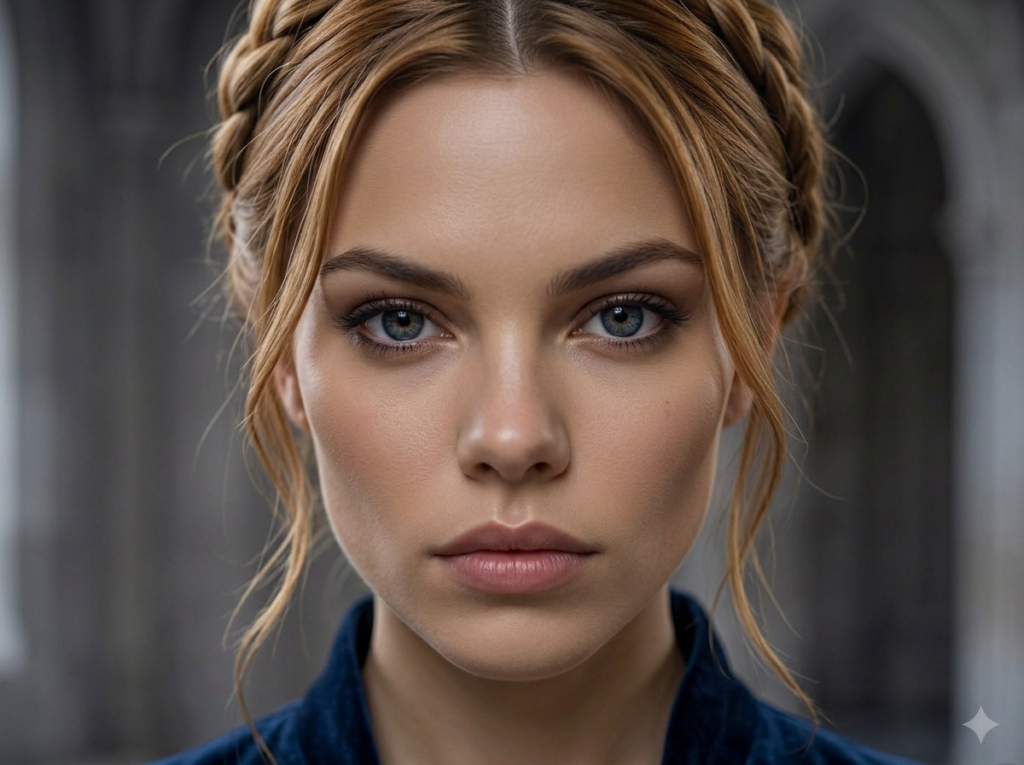
Sharing Feyre’s blue-grey eyes, but where Feyre’s gaze scans outward to track and observe, Nesta’s gaze looks directly through you to cut. In A Court of Silver Flames, Cassian constantly observes that terrifying, unblinking intensity—eyes like steel blades that hold no warmth until she chooses to yield. Her features carry the sharpest aristocratic severity—a knife-edge jawline, high cheekbones, and an unyielding posture, looking just as capable of ending someone on the training ring as commanding the floor at a Hewn City ball.
While Chapter 2 of ACOTAR establishes that all three sisters share the exact same baseline golden-brown hair, Nesta’s often reads visually lighter on that spectrum. That comes down to both her High Fae transformation—where the text in ACOSF highlights how her hair gleams like molten, burnished gold in the light of the House of Wind—and her signature styling. Unlike Feyre’s wind-tousled, tumbled huntress waves, Nesta almost exclusively wears her hair swept up in severe, intricate braided crowns. Tight braiding compresses the hair fibers, creating a flat, high-shine surface that catches and bounces light, pulling those brighter, spun-gold surface ribbons forward.
Elain (The Soft Devastation)
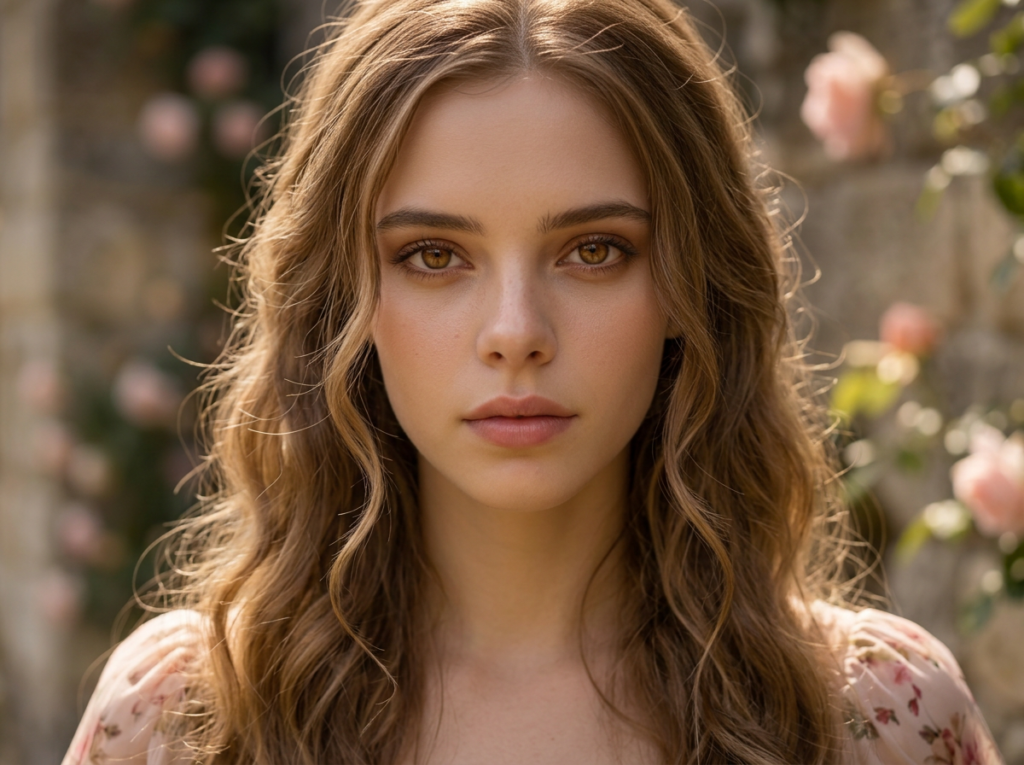
The classic, warm-brown-eyed beauty whose softness is constantly mistaken for helplessness. In Chapter 4 of ACOTAR, Feyre notes that while she and Nesta share stormy sea-eyes, “Elain had eyes the color of rich, warm earth.” In Elain, the shared family cheekbones and jawline are softened by gentle curves. Her eyes hold that dreamy, observant, fox-like quality wrapped in delicate grace—the velvet glove masking the disorienting, uncanny weight of a seer’s vision.
Her hair, as Chapter 2 confirms, shares the family’s signature tone: “…her golden-brown hair, the same shade as mine and Nesta’s, swept up in an artful braid.” In our portrait, she wears it loose with gentle, blooming curls, catching the dappled garden sunlight to bring out the softer honey-chestnut undertones that contrast against Nesta’s severe metallic sheen of her signature crowning braids.
Undeniably sisters, yet completely unique
Bringing Feyre to life wasn’t about generating a pretty portrait; it was about honoring every scar, calorie deficit, and trade route written into her DNA. From Feyre, I wove the genetic tapestry that connects her to her sisters while keeping their canonical differences intact.
When you look at the Archerons in these portraits, you aren’t looking at an algorithm’s average of a fantasy heroine. You’re looking at three women who survived ruin in entirely different ways:
☆ One woman who starved in the cold, inherited the world in her veins, sacrificed everything for those she loved, and walked into Prythian with the earth in her skin and the sea in her eyes to claim her cosmic mate and future.
☆ One woman who was made to rule, armed with sharp edges, an unyielding spine, and a deadly, aristocratic accuracy in her stare—who ripped power from the Cauldron itself, fought through the dark to heal her own soul, and found her sisterhood among the Valkyries.
☆ And one woman whose soft warmth and gentle hands were meant for tending spring soil, torn from her dreams into a world not of her choosing—carrying the terrifying burden of sight while quietly reeling from the ghost of a life she almost had, a wedding forsaken, and a love abandoned. Does that quiet grace mask a blade she’s quietly sharpening in the shadows? Whether that rising power cuts for salvation or destruction, only time will tell.
And by time I mean ACOTAR books 6 and 7 (maybe.)