Field Note 003: The “Tall Girlies Only” Myth — A Textual, Historical & Cinematic Height Analysis of SJM’s Heroines
Search fantasy TikTok or Instagram on any given day, and you’ll run into a recurring meme: “Sarah J. Maas only writes towering 6-foot Amazonian queens.
While the Maasverse certainly loves its 6’4″+ Fae males—often relying on classic cinema visual ratios where a hero comfortably looms a head taller than everyone else—the textual reality of her female leads tells a far more nuanced story.
When you anchor each series to its actual historical era equivalent, factor in developmental nutrition, and analyze the biological laws of human height versus Fae physical transformation, a clear picture emerges: SJM isn’t writing exclusively for “tall girlies.” She is writing across the entire height spectrum.
To understand how these physical pairings work on the page, we first have to look at how SJM borrows from a classic trope rooted deep in romance literature and cinematic history: The “Perfect Fit” Ratio.
The Geometry of Romance: The “Perfect Fit” Cinema Ratio
There is a very specific, cinematic magic in a pairing where one partner stands around 5’4″ and the other sits up at 6’3″. It’s a classic pairing in literature and film that creates a distinct physical dynamic often referred to as the “perfect fit” ratio. And it still tracks with our beloved human-fae mates, and half-human/half-fae and fae… or angel mates that make up the Maasverse!
A nearly 10-to-12-inch gap isn’t just arbitrary; it creates a specific “nesting” effect that visual storytellers have relied on for generations:
-
- The Protective Silhouette: At 6’3″+, a hero’s frame naturally envelops a 5’4″ frame. Whether it’s a standard embrace or simply standing shoulder-to-shoulder, it visually communicates a sense of being grounded and shielded.
-
- The Center of Gravity & Heartbeat Alignment: A 10-to-12-inch difference creates the sweet spot for physical contact. It allows for effortless forehead kisses and places the shorter partner’s head precisely against the taller partner’s chest—right over the heartbeat.
-
- The Visual Contrast: In media and photography, this gap emphasizes a partner’s agility or delicacy without making them feel diminished. It highlights the imposing strength of the taller partner while making the shorter partner’s presence feel intentional and focused.
When we break down the math of these pairings (and yes, this applies directly to how blocking works in those infamous spicy scenes), three distinct vertical ranges emerge:
1. The Sweet Spot: 10 to 12 Inches (25–30 cm)
-
- The Anatomy: The average human head (chin to crown) is about 8 to 9 inches tall. Add 2 to 3 inches from the lips to the chin, and you land right at a 1-foot difference.
-
- The Mechanics: Face-to-face, the shorter character’s eyes align with the taller character’s collarbone or chin. The taller character only needs a slight, natural tilt of the head downward to rest their lips on the crown of the head or forehead.
2. The Bare Minimum for “Towering”: 8 Inches (20 cm)
-
- The Anatomy: The absolute baseline required to create a visual “looming” effect.
-
- The Mechanics: At an 8-inch gap, the top of the shorter character’s head rests level with the taller character’s nose or upper lip. It works, but it requires stepping in very close, resulting in a standard embrace rather than a true “enveloping” silhouette.
3. The Maximum for “Easy” Alignment: 14 to 16 Inches (35–40 cm)
-
- The Anatomy: Think Violet and Xaden in Fourth Wing. The shorter character’s head sits firmly at chest or armpit level.
-
- The Mechanics: While visually dramatic, the taller character has to bend noticeably at the waist or physically lift the shorter character to achieve effortless physical contact.
With this cinematic baseline established, let’s look at how Aelin, Feyre, and Bryce actually measure up textually, historically, and biologically.
Feyre Archeron: Late Medieval / Renaissance Realism
-
- Historical Timeline: 14th–16th Century (Late Medieval / Early Tudor / Renaissance equivalent).
To understand Feyre’s baseline, you have to look at the material reality of her upbringing in early-modern Prythian.
The Human Era Baseline: 4’10” – 5’4″
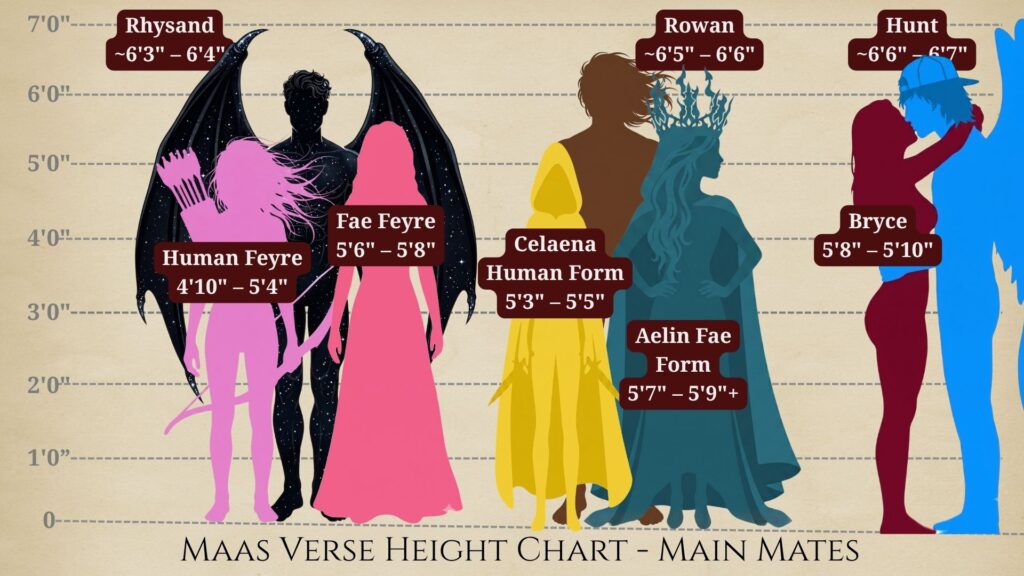
Feyre spent her formative adolescent growth years enduring severe poverty, winter exposure, and chronic malnutrition. In 14th–16th century Europe, caloric restriction during developmental spurts resulted in lower average heights for women (often averaging 5’0″ to 5’2″). Textually, Feyre is explicitly noted as the shortest of the three Archeron sisters.
(Side note on genetic heritage: Feyre is described with golden-brown hair—a soft, earthy brown that catches light—and skin with warm, radiant undertones. Coupled with her father’s history as a far-reaching merchant prince, her physical traits subtly highlight a rich, multi-ancestral background that sets her aesthetic apart and more diverse from standard northern European fantasy tropes! It’s also why I’ve bumped up her height range from a max of 5’2” to 5’4” to account for several places in the world at that time with olive skin toned people who had taller statures than their northern european counterparts. We go more in depth on this here.)
The High Fae Shift: 5’6″ – 5’8″
When Feyre is Made High Fae at the end of A Court of Thorns and Roses, her physical anatomy undergoes a literal bodily expansion. The text explicitly notes that she stumbles while walking as her brain recalibrates to longer strides and lengthened limbs.
-
- The Ratio Check: Even with her physical transformation lengthening her to around 5’7″, Rhysand (standing at roughly 6’3″ to 6’4″) maintains that classic 8-to-10-inch “Sweet Spot” gap. He still comfortably looms over her, keeping their cinematic pairing intact and consistent with their many, many spicy scenes.
Now Feyre goes from a shorter girly to a tall(ish) girly… but her power and resilience are always the same regardless of her height. And Rhysand was drawn to her in all her human and fae forms.
Aelin Galathynius: Pre-Industrial Trajectory & Fae Biology
-
- Historical Timeline: 1780s–1830s (Regency / Pre-Industrial equivalent).
Aelin’s height curve is unique because her story sits in a Regency/Pre-Industrial era world—complete with expanding urban centers, refined medicine, and better baseline nutrition than Late Medieval Prythian—combined with Fae maturation laws.
The Human/Assassin Era: 5’3″ – 5’5″
In Throne of Glass, Celaena Sardothien is repeatedly described as average in stature for a human woman in Adarlan. And characters are even surprised to mention how average her height is because her personality seems so much bigger. In a late-18th/early-19th-century context where female heights averaged around 5’3″, she stands as a nimble, proportional human assassin in her younger years in the early books.
The Settled Fae Growth Phase: 5’7″ – 5’9″
Maas lore establishes that Fae physical maturation settles in their mid-twenties, accompanied by a final physical settling phase. When Aelin shifts fully into her Fae form, her frame lengthens. And throughout the books, how her height is described shifts, highlighting she was still growing due to her fae ancestry as she was years from Fae maturation where her body would slow down the clock on her aging process.
-
- The Verdict: Because the core series concludes while Aelin is still in her early twenties, she represents a heroine actively mid-growth trajectory—starting at an agile 5’3″–5’4″ human form baseline and steadily settling into a 5’8″ or more half-human/half-fae frame.
Bryce Quinlan: Modern Proportions & Curved Silhouettes
-
- Historical Timeline: Modern 21st-Century Equivalent.
Unlike Feyre and Aelin, Bryce grows up in Lunathion—a modern global metropolis with advanced medicine, contemporary nutrition, and 21st-century athletic lifestyles. We get very New York merged with magic vibes.
Modern Baseline: 5’8″ – 5’10” (5’11″+ in Heels)
Bryce’s half-Fae heritage gives her naturally longer limb proportions just like Aelin, but her backstory notes she was deemed “too tall” and too curvy for traditional professional ballet standards.
-
- The Ratio Check: Standing at a natural 5’8″ to 5’9″, Bryce routinely steps into high heels that push her to 6’0″+. When standing next to Hunt Athalar (who easily clears 6’6″+), her heels bring them into that 4-to-6-inch “nose-to-nose” dynamic, while her flat-footed baseline preserves the classic height gap.
Summary Baseline for Future Character Builds
When we evaluate height across the Maasverse, SJM isn’t breaking biological or historical rules—she’s leaning into them:
| Female Lead | Historical Era Equivalent | Human / Baseline Height | Settled Fae Height | Mate, Estimated Height Range & Visual Dynamic |
|---|---|---|---|---|
| Feyre Archeron | 14th–16th C.(Late Medieval / Tudor) | 4’10” – 5’4″(Scarcity & trade baseline) | 5’6″ – 5’8″(Post-Made transformation) |
Rhysand (~6’3″ – 6’4″)
|
| Aelin Galathynius | 1780s–1830s(Regency / Pre-Industrial) | 5’3″ – 5’5″(Agile Adarlan average in human form) | 5’7″ – 5’9″+(Settled Fae form maturation) |
Rowan Whitethorn (~6’5″ – 6’6″)
|
| Bryce Quinlan | Modern 21st Century | 5’8″ – 5’10”(5’11″+ in heels) | N/A(Half-Fae baseline) |
Hunt Athalar (~6’6″ – 6’7″)
|
This historical and textual framework gives us a clean baseline for future breakdowns of side characters, High Lords in more detail, and Cadre members!