Field Note 009: The Anatomy of Fae Ears: Subtle Lethality vs. Satellite Tropes
Pointed ears are the quintessential calling card of the fae genre. Yet in popular romantasy art, fan interpretation frequently defaults to oversized, high-angled satellite ears that flare dramatically outward.
How I have always envisioned fae ears takes a deliberate departure from the high-fantasy elf aesthetic. In these builds, the ears sit close to the skull—tapered, subtle, and frequently obscured by hair. You only catch the lethal sweep of cartilage from a side profile or in close proximity. It leans into pure predatory biology: you don’t realize you are standing next to an apex predator until you are already within striking distance.
This design choice is anchored directly in how Sarah J. Maas textually differentiates Fae anatomy across ACOTAR, Throne of Glass, and Crescent City, merged with my own artistic vision of her worlds.
Note: This anatomical catalog focuses strictly on primary Fae protagonists across Prythian, Erilea, and Midgard; peripheral species, lesser Fae, and broader Vanir lineages exhibit far wider morphological variation.
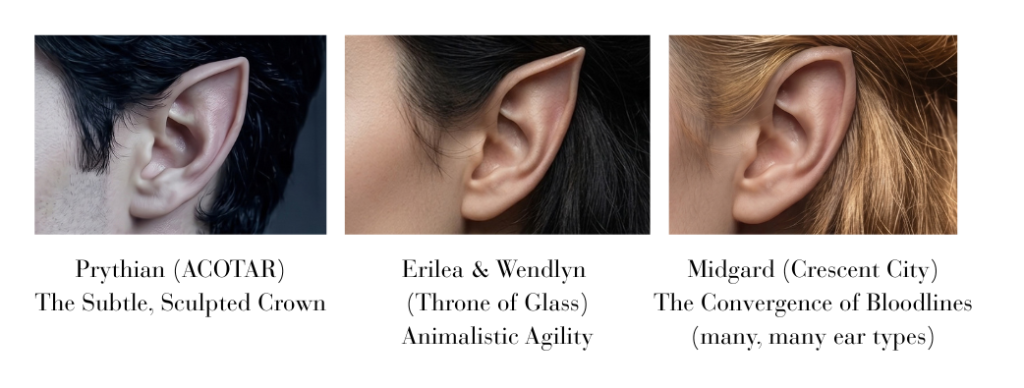
Prythian (ACOTAR): The Subtle, Sculpted Crown
ACOTAR presents the most refined, understated iteration of the trait. The point is not an alien protrusion; it is an elegant extension of humanoid bone structure.
- ACOMAF, Chapter 16: When Feyre arrives at the House of Wind and observes Cassian and Azriel, she compares them against High Fae anatomy: “Their ears were slightly curved, but not pointed like the High Fae. More rounded, like a mortal’s.”
- The High Fae Distinction: Feyre notes that High Fae ears possess a graceful, tapered tip that blends seamlessly into the temples, rather than winging outward. It is an accent of royal, ancient lineage—easily masked by falling hair or a hood, making High Fae look nearly human except for their uncanny perfection… until the light shifts and we see their lethal, wild nature.
Erilea & Wendlyn (Throne of Glass): Animalistic Agility
In the Throne of Glass universe, Fae biology leans heavily into visceral, predatory instinct. Their physical traits reflect creatures built directly for hunting and open terrain.
- Heir of Fire, Chapter 9: When Celaena first encounters Rowan Whitethorn in his Fae form, his features are described through the lens of a predator: high cheekbones, lethal grace, and ears that taper into sharp, deliberate points designed for heightened sensory tracking.
- The Textual Receipts: Throughout Heir of Fire and Queen of Shadows, Rowan and the cadre’s ears appear to subtly twitch or angle toward faint sounds. The cartilage is sharper, slightly more pronounced, and kinetic—retaining the animalistic feral edge tied to their shifting forms.
Midgard (Crescent City): The Convergence of Bloodlines
Crescent City offers the widest physiological spectrum, which aligns with Midgard’s history as a melting pot of peoples pulled through the Northern Rift from different worlds. It has all the ears.
- House of Earth and Blood, Chapter 5: Bryce Quinlan’s heritage highlights the physical spectrum between Vanir, High Fae, and humans. Characters like Ruhn Danaan carry classic, aristocratic High Fae points, while mixed bloodlines show softened, barely tipped curves.
- The Lore Tie-In: With Midgard’s Fae likely originating from both the Avallen (resembling the shadow-touched, subtle nobility of Prythian) and the Valbaran lines (resembling the ancestral bloodlines of Erilea), the variance in ear shape reflects their cross-world genealogy.
The Design Blueprint
| Realm | Textual Tone | Cartilage Architecture | Visual Presence |
|---|---|---|---|
| ACOTAR | Regal & Classical | Subtle, sleek tips flush with skull | Masked by hair depending on style and length; visible primarily in profile |
| Throne of Glass | Feral & Instinctual | Sharper points; acute sensory tracking | Noticeable, athletic, animalistic edge |
| Crescent City | Diverse & Ancestral | Variable taper based on generational lineage | Spectrum ranging from refined to pronounced |
By keeping our ears tight to the head and delicately tapered, the silhouette preserves human familiarity right up until the moment the predator reveals itself.