Field Note 012: The Fourth Wing Casting Part 2 - The "Unrealistic AI Standards" Myth vs. Decades of Media Body Politics
Field Note 012: Body Politics, Living Human Proxies & AI Scapegoating Matrix
- Living Human Proxies vs. Synthetic Images: Under Leon Festinger’s Social Comparison Theory, comparing oneself to a living human actor creates far deeper psychological harm than an AI image. A real person on screen is perceived as an achievable human baseline, whereas synthetic AI can be explicitly labeled, regulated, and scaffolded to create ontological distance.
- The AI Scapegoat vs. Legacy Media: Blaming AI for inventing impossible body standards is a convenient distraction. Legacy Hollywood has spent decades causing severe body image harm through extreme actor cuts, corporate airbrushing, and toxic editorial standards long before generative tools existed.
- The "Battlefield Waif" & Chronic Illness: Rebecca Yarros wrote Violet Sorrengail with an Ehlers-Danlos syndrome (EDS) analogue, combining physical vulnerability with functional muscle and endurance. Fandom discourse often struggles when an adaptation casts an actress with genuine physical presence instead of conforming to an idealized, fragile aesthetic.
- Analytical Findings & Art and AI Homogenization: Critiques of visual media must distinguish between what tools actually generate and the cultural standards set by legacy media. Addressing body image requires holding the entertainment industry accountable for living proxies rather than scapegoating emerging technology on a whole.
Once the initial wave of casting toxicity hit social media, a fascinating second wave of discourse immediately took over BookTok.
Defenders of the casting—from video essayists to lifestyle creators—had a knee-jerk, defensive reaction. Instead of addressing the fandom’s biases or the institutional reality of studio systems, they rallied around a single, viral talking point: “You only hate this casting because you’re addicted to unrealistic AI beauty standards and AI slop.”
It sounds sharp in a thirty-second clip, but the second you test that claim against psychological science and empirical reality, the argument completely collapses.
The Reality of the Cast: Hollywood Aesthetics, Not Algorithmic Inventions
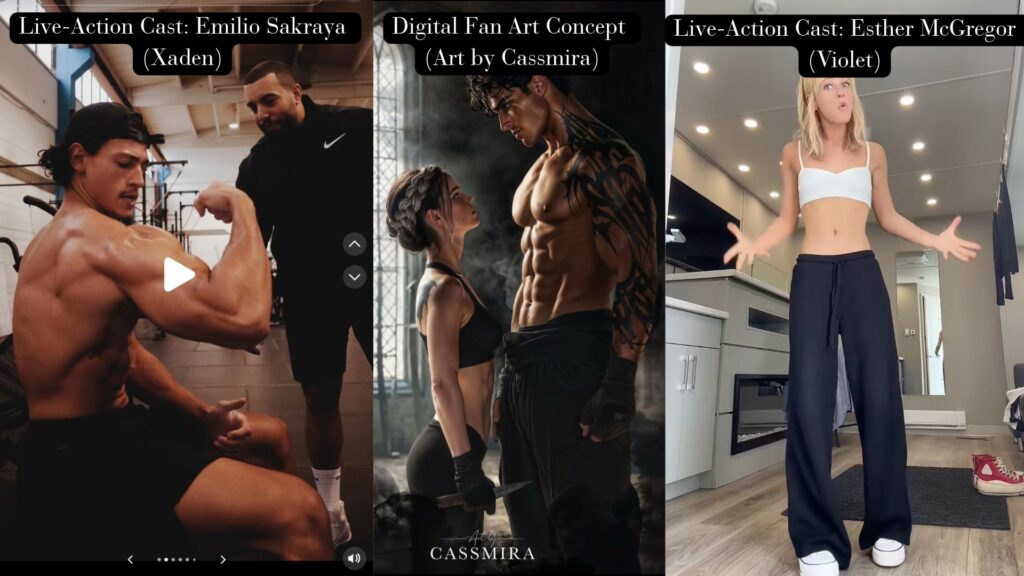
Let’s look honestly at the two actors standing in front of us. Esther McGregor and Emilio Sakraya are deeply talented performers, but they are also the textbook definition of elite, legacy Hollywood aesthetics. Sakraya possesses a peak-action, hyper-sculpted, sub-8% body-fat physique—a physical state that male leads routinely achieve through punishing training cycles, severe caloric deficits, and deliberate dehydration protocols prior to shoot days. McGregor possesses a naturally ultra-slender, runway-standard silhouette.
If you pull up popular digital and AI fan concepts of Violet and Xaden side-by-side with these two actors, they look remarkably comparable. In fact, many independent digital illustrations depict a noticeably less shredded Xaden, or a Violet with a fuller, softer frame than the runway-level thinness selected by Amazon's casting team.
The argument that audiences are rejecting these actors because digital art built an "impossible, unreachable beauty standard" makes zero sense when the real-world actors chosen by the studio already occupy the narrowest upper percentile of commercial glamour.
Decades of Harm: What Psychology Actually Tells Us About Body Image
Unrealistic body standards did not arrive with generative algorithms. To claim otherwise is historical revisionism that lets multi-billion-dollar entertainment conglomerates off the hook for nearly a century of documented cultural harm.
Decades of clinical psychological research—grounded in Leon Festinger’s Social Comparison Theory and extensive studies on thin-ideal internalization—have demonstrated that exposure to idealized media wreaks havoc on body image. But there is a crucial nuance that social media commentators are completely ignoring: perceived attainability and biological plausibility.
In psychology, upward social comparison causes the deepest psychological damage when the target is perceived as a biological peer. When we see a living, breathing human actor on screen embodying an extreme, hyper-lean silhouette, our brains unconsciously register that image as an attainable biological standard. It creates an insidious psychological bridge: If another human can exist like this, my inability to achieve it is a personal, physical failure.
When digital fan art or concept builds are created and transparently shared, they provide what cognitive psychologists refer to as ontological distancing. The viewer’s brain categorizes a digital canvas as an imaginative archetype, a stylized myth, or an artistic construct rather than a biological peer. That transparent scaffolding makes it far easier to deconstruct the image mentally.
Historically, mass media has inflicted significantly deeper psychological damage precisely because it demands that living human beings conform to retouched, dieted-down, and dehydrated ideals—the exact commercial imagery that early generative datasets scraped in the first place. The algorithm didn't invent the aesthetic; it merely learned the visual vocabulary legacy media has spent eighty years monetizing.
Conflating Chronic Fragility with Runway Waifishness
This dynamic becomes especially critical when we look at how Violet’s physical canon is being discussed online.
In Rebecca Yarros’s canon, Violet Sorrengail’s small stature is not a runway aesthetic; it is inextricably bound to joint hypermobility, tissue fragility, and chronic pain—drawn directly from Yarros’s own lived experience with Ehlers-Danlos syndrome. Applauding McGregor’s naturally ultra-slender, runway-standard silhouette as the definition of "authentic, grounded chronic illness" conflates runway waifishness with disability representation.
Let's do a necessary reality check: as someone who lost a close childhood friend to an eating disorder fueled by media representations and the relentless pressure to look like a specific actress, this conversation hits deep. We have no idea if McGregor’s thinness is a genetic baseline or part of her own private journey. We should be celebrating her dramatic talent to embody Violet while consciously refusing to conflate her acting ability with her dress size. Separating talent from physical measurements is how we show up for an actress through a lens of health and inclusion, rather than placing an ultra-fragile silhouette on an aspirational pedestal for young audiences.
The Publishing Machine's Role: Down-Aging and the Myth of the "Battlefield Waif"
Fantasy publishing isn’t an innocent bystander in this dynamic either. The genre routinely reinforces these identical aesthetic biases through a toxic cocktail of chronic "down-aging" and biological contradictions written right onto the page.
Publishing houses love stamping heroines with early-twenties birth certificates to hit commercial demographic sweet spots, while writing them with the emotional processing, strategic command, and prefrontal cortex development of someone well into their thirties. But the body politics run just as deep as the ageism. We are constantly sold the fantasy of the "battlefield waif"—a tiny, delicate, twenty-year-old girl who spends chapters doing brutal physical conditioning, yet somehow retains the silhouette of a high-fashion runway model. She magically wields broadswords, snaps necks, out-grapples career brutes twice her size, and cleaves through armies without putting on an ounce of visible lat development, functional quad mass, or core density.
God forbid a female warrior actually look like she can lift a battleaxe.
Instead, the page insists she must remain impossibly slender, delicate, and perpetually twenty just to stay "marketable." That paper-bound fantasy feeds right into studio casting pipelines, ensuring live-action heroines remain conventionally youthful waifs regardless of the grit and maturity written into their actions. What would it mean to cast seasoned performers who possess the emotional depth to embody these characters, detached from arbitrary age brackets? What would it look like to see women on screen whose physiques actually match their battlefield survival?
Stop Blaming the Mirror for the Monster in the Room
AI is not the root issue of modern body politics. It is simply a convenient scapegoat used by commentators to defend corporate studio choices and avoid a far more uncomfortable conversation: legacy media and commercial publishing are still profiting from the exact same exclusionary aesthetic they have pushed for generations.
The algorithm didn't invent our culture's obsession with unattainable bodies—it just held up a mirror to an industry that has been selling them to us for eighty years.
From the easel,
Written by The Atelierist
Transmedia creative director and visual lore archaeologist reconstructing fantasy character likenesses from the bones up. Excavating Sarah J. Maas canon through comparative skeletal anatomy, historical period likenesses, and narrative worldbuilding at Romantasy Atelier.